
Resources library
Welcome to our resource library. We invite you to explore and view our extensive resources and information.
OXB Global Brochure 2026
This brochure highlights OXB's capabilities, showcasing our platforms, technical expertise, and client-centric ways of working across the cell and gene therapy journey.
View Resource >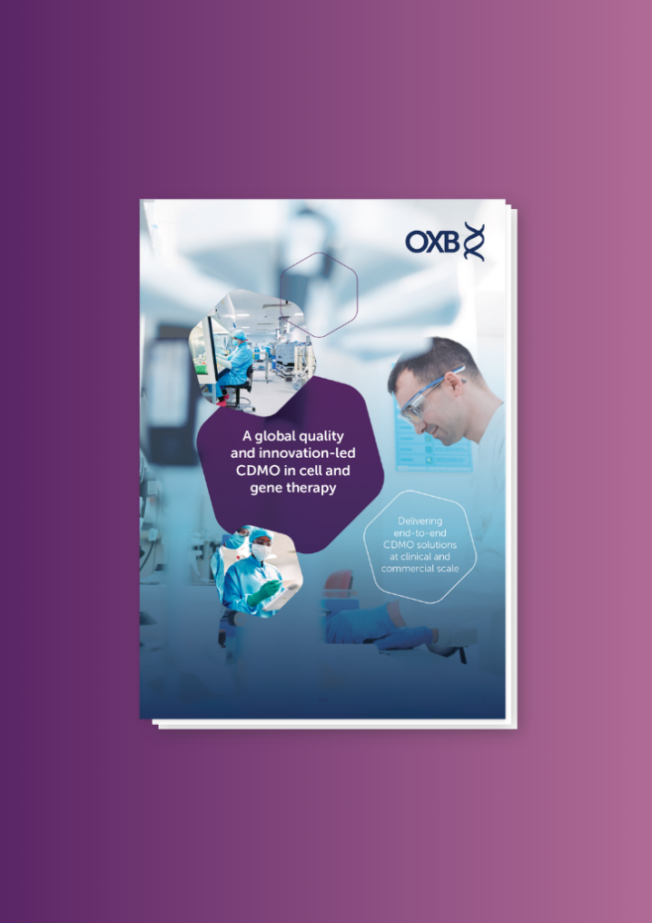
Late-Stage Capabilities One Pager
Learn how OXB supports the transition from late-stage development to commercial supply through proven expertise in process characterisation, PPQ, regulatory submissions and commercial-scale GMP manufacturing.
View details >
Isolating T-Cell Potent Lentiviral Vector Subpopulations through Rational Design of Nanofiber Anion-Exchange Adsorbents
This paper investigates lentiviral vector heterogeneity during anion-exchange chromatography and identifies a nanofiber-based purification approach that enhances recovery and separation of high-potency vectors.
View details >
In vivo CAR‑T – Reimagining Immune Engineering with Direct Cell Reprogramming
An overview of the opportunities and challenges of in vivo CAR-T therapy, including the technologies that could transform how next-generation cell therapies are delivered to patients. Published in The Medicine Maker.
View details >
Efficient In Vivo Generation of CAR T Cells using a Retargeted Fourth-Generation Lentiviral Vector
View details >Infographic: The 7 Regulatory Milestones Every Viral Vector Developer Should Plan For
A practical visual roadmap outlining the seven key regulatory milestones viral vector developers should consider from early development through lifecycle management.
View details >
5 Questions with… Melanie Kearney
Quality is about more than compliance. It's about building confidence at every stage of development. In this edition of 5 Questions with..., Dr. Melanie Kearney, SVP, Global Head of Quality at OXB, explores why Quality should be embedded from the very beginning of a cell and gene therapy programme.
View Resource >